The best quiz questions to boost engagement
In today’s digital environment, simply publishing a quiz is no longer sufficient.
To truly make an impact, you need the best quiz questions to boost engagement.
Right away, let’s set the scene: you already know how quizzes work, how they capture attention, gather leads, and spark share-worthy interactions.
What you may still be refining is which specific questions raise participation, lower drop-outs and elevate the experience.
This article dives into that next level: the architecture of high-engagement quiz questions. You’ll learn storytelling, psychology, and practical examples driven by real data.
By the end, you’ll have a refined toolkit of question types, cues and strategies you can plug into your next lead-magnet or interactive content piece, adapting to your audience’s mindset, your platform, and your conversion goals. Let’s get into it.
Why question design matters (and what the data say)
Engagement is more than you think
Interactive content is gaining traction for very specific reasons. For example, one report finds that interactive content like quizzes, can increase engagement by up to 70% compared to passive content.
But engagement isn’t simply “people click and finish.”
It means that participants start, meaningfully engage with each question, and proceed through to a result.
One benchmarking analysis shows completion-rates for quizzes:
- Short quizes (3-7 questions): ~65–85% completion
- Medium (8-15 questions): ~45–65%
- Long (16+ questions): ~25–45%
That means question design is a critical lever. Not just the number of questions, but how each question earns attention and moves the user forward.
The first few questions set the tone
Research indicates that ramp-up matters: on mobile, in particular, a quiz that takes under 5 minutes retains ~80–90% of participants, while 5-10 minutes drops to ~60-80%.
The first two or three questions are especially critical because they establish momentum and either hook or lose the user.
Design elements that support high-engagement questions
Across multiple sources, we see these recurring themes:
- Variety in question format (multiple choice, true/false, matching, open ended) boosts retention.
- Multimedia (images/videos) and visual cues increases retention and user satisfaction.
- Clear relevance and personalization to the audience.
- Progress indicators, instant feedback and optimized length.
With this foundation, let’s move into how to craft the best quiz questions to boost engagement.
How to craft high-engagement quiz questions
Understand your audience’s mindset
Before you write even the first question, ask: What is the mindset of the quiz taker right now?
They may be in awareness stage, consideration, or decision stage.
Since your target is a mid/funnel or bottom-of-the-funnel audience (“they already understand the subject and are ready to act”), your questions must respect that depth.
For example: instead of asking “Which type of marketing are you?” you might ask “Which of these three lead-gen strategies has produced ___% better conversion for you in the past 6 months?”
This assumes familiarity, speaks to actual business outcomes, and primes a deeper engagement.
Use question types that trigger active thinking
Here are some question types and templates tailored for audiences who are beyond basic awareness:
Scenario / challenge questions
- “Imagine you allocated 40% of your digital budget to interactive content and saw only 8% lift, what’s the most likely reason?”
- “Your quiz completion rate fell from 72% to 49% after adding 6 extra questions. Based on benchmarks, which fix gives the biggest boost?”
These types of questions do three things: they place the user in a decision-moment, they reference metrics they care about, and they invite them to compare their experience to benchmarks.
Peer-comparison / social-proof question
- Among 500 marketing leads, which approach did peers report as most effective for increasing quiz completion:
(A) reducing to 7 questions
(B) adding a ‘share results’ prompt
(C) including open-ended feedback?
By referencing “what peers did”, you tap into social validation.
Self-assessment / readiness check question
- “On a scale of 1-5, how optimized is your quiz-intro for mobile? (1 = not at all, 5 = fully). Then ask: Which element are you missing?”
This helps the user reflect, which deepens engagement.
Ranking or priority question
- “Rank these elements in order of what you think most influences quiz share-rate: visuals, progress-bar, CTA, question length.”
Ranking tasks give control and ownership to the user, boosting engagement.
Split-path/segmented question
- “Are you creating this quiz for:
(A) lead-gen
(B) training/test
(C) gamified brand experience?
Based on your answer we’ll direct to a tailored path.
Segmenting paths increases relevance and keeps the user feeling the quiz is customized to them.
Question wording matters: precision + hooks
Now you have the types; next you refine how each question is phrased:
- Use active language: “Which metric dropped when you added extra questions?” rather than “What was affected?”
- Keep each question simple and unambiguous (avoid heavy jargon, unless you know your audience uses it). The simpler the question, the smoother the completion.
- Incorporate curiosity hooks: Question 1 might say “You added 6 questions and lost 23% in completion. Why?” That sets a puzzle they feel compelled to solve.
- Use numbers where possible: “You lost 23%” or “completion rose by 12 points” gives specificity and credibility.
- Ensure each question adds value, self-reflection or benchmark comparison. Avoid filler questions, since drop-off often stems from perceived “why am I answering this?”
Optimize quiz flow & structure
The question order and structure affect engagement. Here are practical design patterns:
- Start with a warm-up, low-resistance question: Something simple they can answer quickly to build momentum.
- Middle questions escalate: Mix in deeper challenge or decision-type questions.
- Before the result, include a reflection / share prompt question: For example “Which result did you find surprising? Why?” (if open-ended) or “Would you like to share your result?”
- End with a question that sets up your CTA: “Are you ready to apply these best-practice questions in your next campaign?” This primes the transition.
- Use a progress bar or indicator to show movement; research shows it reduces drop-off.
- Ensure the quiz is mobile-friendly given mobile traffic dominance, a non-optimized quiz can tank completion rates.
Sample question list: the Best Quiz Questions to Boost Engagement
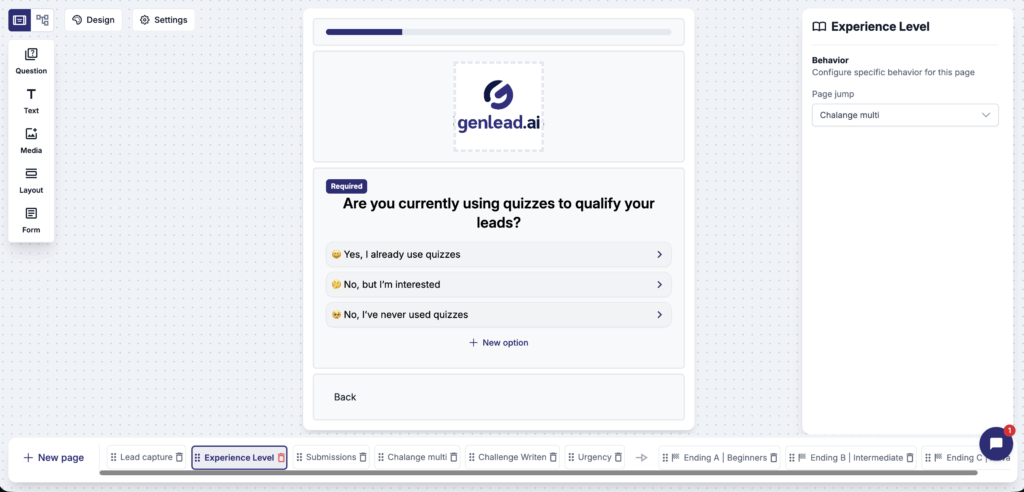
Here’s a curated list of sample questions you can adapt.
These are designed for an audience familiar with quiz-marketing and digital engagement strategies:
- Warm-up:
“How many interactive quizzes has your team published in the last 12 months?”
(Options: 0-2, 3-5, 6-10, 11+) - Benchmark comparison:
“If your quiz has 12 questions, what completion-rate range did you expect?”
(Options: 50–60 %, 60–70 %, 70–80 %, >80 %) - Scenario challenge:
“You added three multimedia questions (video/audio) into your quiz. All else equal, which effect is most likely?”
(Options: A) 15–20% higher completion, B) no change, C) 10% lower completion) - Ranking/prioritizing:
“Rank the following items in order of their likely impact on quiz share-rate: visuals, CTA, personalized result, number of questions.” - Self-assessment:
“On a scale of 1-5, how well is your quiz optimized for mobile (1 = not optimized, 5 = fully optimized)?” - Peer-comparison/social proof:
“Which metric did your industry peers report as the most improved by using adaptive question paths?”
(Options: completion-rate, share-rate, lead-quality, time-spent) - Decision-path segmentation:
“What is your primary goal for your next quiz?”
(Options: lead generation, sales qualification, brand engagement, training)
Follow-up: Based on your choice, you’ll receive tailored question-templates. - Reflective question:
“Which one quiz question in your current quiz would you rewrite, if you knew it dropped engagement by ~12%?” - CTA-preparation:
“Are you ready to apply a revised set of 5 high-engagement questions in your next campaign?”
(Options: Yes, I already have; Yes, need templates; No, I need help) - Share prompt:
“Would you like to share your quiz result with peers or your team to spark discussion?”
(Options: Yes, No)
Technical considerations for question delivery
When questions are live, the technical delivery affects perceived quality and completion:
- Ensure fast load times: every second delay correlates with higher drop-off.
- Use adaptive logic (skip paths, show/hide questions based on prior answers) to reduce unnecessary questions and increase relevance.
- Design for accessibility and mobile responsiveness: fonts, taps, visuals should behave well on mobile.
- Integrate instant feedback or micro-rewards between questions if appropriate, this gives a sense of progress and reinforces engagement.
- Place identification or lead-capture after the user is invested (i.e., toward the end), not at the start when engagement is fragile.
Measuring question effectiveness
Knowing which questions are doing heavy lifting is key to refinement:
- Track drop-off by question: where are people quitting? If question 3 consistently loses 20%, it needs redesign.
- Look at time per question: too fast may mean skimming; too slow may mean confusion.
- Monitor share-rate of quiz results: questions that evoke sharing often combine surprise + relevance.
- Check lead-quality downstream: did quiz takers convert? Which question answers correlated to better conversion?
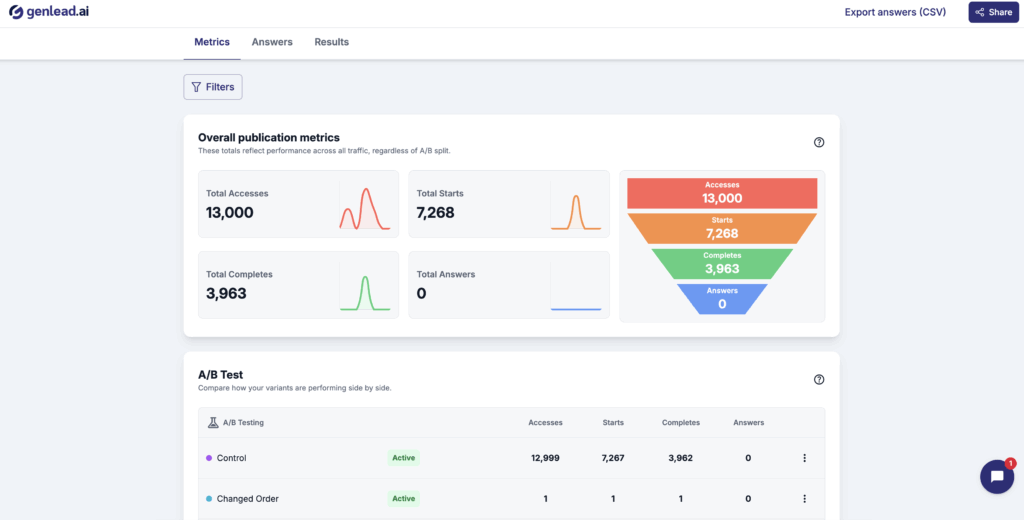
- Use A/B testing: test question wording, format, placement (e.g., image vs no-image) to optimize performance.
Storytelling through quiz questions, making the experience memorable
Let’s flip from technique to narrative. To illustrate how the best question design meets storytelling, let me set a mini-story:
Case study: “BrightSpark Marketing”
BrightSpark launched a quiz titled “What Type of Lead Magnet Will Double Your List?”.
Early analytics showed a 38% completion rate. They hypothesized weak question hooks and low relevance.
They rewrote the first two questions:
- Q1: “Your last lead magnet added only 120 emails in 30 days, what’s the most likely weak link?” (options: traffic, offer, design, follow-up)
- Q2: “You have 1,000 visitors/month who bounce in <10 seconds. Which quiz question would best diagnose the issue?”
They also added a scenario question mid-quiz: “Sarah spent $2,000 on ads, got 48 leads, quiz completion was 27%, what should she test first?”
The result: completion rate rose to 63%. More importantly, 45% of respondents shared their result on LinkedIn. The story-style questions gave context, relevance and stirred curiosity.
From this example you see how the best quiz questions incorporate story context: “Sarah”, “you have 1,000 visitors”, “your last lead magnet” etc, to make the questions relatable, credible and urgent.
Tips for weaving story into quiz questions
- Use characters or user archetypes (e.g., “Sarah, the content marketer”) rather than abstract “you”.
- Embed time or metric details (e.g., “in 30 days”, “1,000 visitors”) to increase realism.
- Pose a dilemma or challenge. Quizzes previously felt like tests; high-engagement questions feel like decisions.
- Use direct address (you, your) to pull the participant into the narrative.
- After the quiz, show how their answer path reflects a “story outcome” e.g., “Based on your responses, you’re in the ‘Conversion Optimizer’ path and your next step is…”
Common pitfalls to avoid and how question design prevents them
Since your audience already knows about quizzes and engagement tactics, let’s go beyond basics and look at common traps that even experienced practitioners fall into, and how question design mitigates them.
Too many filler questions
When a quiz (especially for mid-funnel audiences) adds questions for “more data” but doesn’t increase relevance, users drop off. The fix: each question must earn its place. Ask: what decision or insight does it enable? If none, remove it.
Generic, shallow questions
Questions like “What type of learner are you?” or “Which colour palette do you prefer?” often feel disconnected from outcome. For an informed audience, they feel trivial. Instead, craft questions that reference real business or behavioural context (“Which ad format had <2% CTR and needs optimization?”).
No clear path from question to outcome
If the quiz asks meaningful questions but the result feels random or unrelated, users feel cheated. The question-to-result link must be coherent and the logic transparent.
Failing to reflect the audience’s sophistication
If your audience already works on engagement strategies, asking basic questions reduces trust. The best quiz questions for such audiences move deeper: they assume foundation knowledge and engage with tactics, metrics, trade-offs, rather than surface traits.
Ignoring mobile user behaviour
A question heavy on text, with no visuals, and long scroll can eat momentum on mobile. Ensure each question is concise, uses imagery when relevant, and loads quickly.
Advanced question design strategies for mid/funnel audiences
Since you’re targeting an audience that already “knows stuff”, you can step up to advanced strategies.
Use “challenge vs benchmark” questions
- “You’re getting a 42% completion rate but share-rate is only 6%. Which change is more likely to improve share-rate by 10 points?”
These kinds of questions invite reflection on trade-offs and let users test their own hypotheses.
Use “branching narrative” questions
Based on their response, you can route them to different sequences. Example:
Q1: “What’s your current quiz completion rate?” (Options: <50%, 50-70%, >70%)
Depending on answer, you branch into different question sets focused on lower/higher completion. This creates personalization and keeps relevance high.
Use “data-driven scenario” questions
- “In a dataset of 5,000 quiz takers, you discovered that removal of one question lifted completion from 55% to 69%. What was the most probable reason?”
By referencing a dataset, you speak directly to this audience’s interest in metrics and outcomes.
Use “future-looking / strategy” questions
- “If your competitor launches an AR-integrated quiz next quarter, what question innovation will you test by then?”
This moves the quiz from evaluation into strategic planning.
Use “feedback loop” questions
At some point you may want to ask:
- “Which quiz question in your current funnel surprised you most when you looked at question-by-question drop-off metrics?”
This taps into reflection and positions the quiz as a learning tool, not just lead gen.
Integrating questions into your quiz build & campaign
You have the best quiz questions; now think about the logistics of how they fit into your funnel and campaign.
Placement & CTA alignment
Your questions should map to your campaign goals. For instance: if you aim to generate leads for a workshop, include questions that filter readiness and budget.
At the end, your result and CTA might be: “Based on your responses, you qualify for our 90-minute workshop. Click below to book your slot.”
The preceding question might have asked: “Which of the following best describes your current monthly budget for lead-gen?”
Promotion and traffic source matching
Questions and their context should align with how the user found the quiz. For example, traffic from a paid ad may need simpler, curiosity-driven first questions; traffic from an email list of engaged subscribers can dive deeper immediately.
Benchmark data show that completion rates differ significantly by traffic source.
Social sharing built into the question and result flow
Quizzes perform well when their questions and result pathways encourage sharing.
One trick: include a question like “How many of your colleagues would you challenge to take this quiz and compare results?” This priming helps lead to a share at the end.
Also ensure result screens have clear sharing buttons and the question context leads into a result that participants want to show others (“You’re the Conversion Catalyst – 68% of your peers need to test their quiz questions now”).
Post-quiz nurture triggered by question outcomes
Each question gives insight. If, for example, a quiz taker selects “I don’t collect mobile analytics” in one question, you can segment them into a nurture track that covers mobile optimization.
That means your questions not only boost engagement, they enable smarter follow-up.
What the best quiz questions don’t do
To stand out, it also helps to understand what to avoid.
- They don’t ask purely demographic questions early on (unless absolutely necessary). Starting with “What’s your role?” loses momentum.
- They don’t assume the participant doesn’t know anything. For mid/funnel audiences, questions must respect their knowledge, not quiz them on basics.
- They don’t bury the user in long text or multiple sub-clauses. Each question is crisp and focused.
- They don’t ignore visuals, mobile behaviour or user experience issues. A dull or slow question breaks engagement.
- They don’t leave the user wondering “why am I answering this?” Every question must feel relevant to their goal.
Real-world example: turning question design into engagement
Here’s how a marketing team applied these principles:
- They wanted to boost leads for a white-paper download via quiz.
- They designed a quiz with 8 questions (within the 7-10 optimal range for casual engagements).
- Q1: “Your last campaign cost $8,000 and generated 430 leads. What was the likely weak link?” (scenario question)
- Q2: “What’s your team’s average quiz completion rate in 2024?” (self-assessment)
- Q3: “Which of these three question-types did you use least: image-based, open-ended, branching?” (ranking)
- Q4: “If your drop-off occurs at question 3, what is your first corrective action?” (benchmark/decision)
- Q5: “Which share-strategy gave you the highest uplift: embedded share button, prompt to challenge friend, or leader-board?” (peer-comparison)
- Q6: “On mobile, your quiz finished in 5 minutes, what’s the probable completion rate range?” (data-driven)
- Q7: “Which metric improved most after you added immediate feedback between questions?” (scenario)
- Q8: “Are you ready to implement a revised high-engagement question set now?” (CTA prep)
They inserted a progress bar after Q3. They collected analytics; drop-off after Q3 dropped from 18% (old quiz) to 8%.
Share-rate doubled. Leads post-quiz had 22% higher conversion in the nurture funnel.
The differentiator? Each question was intentional, scenario-based, metric-driven and connected to behavior, not generic.
When you revisit your quiz: checklist for question-quality
Before you publish your next quiz, run through this small checklist (tailored to question design for engagement):
- Does each question relate to a decision or trade-off the user cares about?
- Is the wording crisp, active and relevant to a mid-funnel audience?
- Is the question visually and structurally optimized for mobile?
- Does the question build relevance early (first two questions earn trust)?
- Is there variety in format (scenario, self-assessment, ranking, decision)?
- Is there a story or context embedded (metrics, scenarios, real-world action)?
- Does the quiz avoid glossing or irrelevant filler questions?
- Is the question flow aligned with your result / CTA and traffic source?
- Are you tracking question-by-question drop-off, time per question, and share rate?
- Have you considered branching logic or adaptive paths based on prior answers?
A word on testing and optimization
Even the best quiz questions benefit from optimization. A/B testing matters here:
- Test question order: swapping Q2 and Q3 might improve completion.
- Test variations in wording: e.g., “Which of these metrics dropped first?” vs “Which of these metrics is most likely to drop first?”
- Test format changes: multiple-choice vs image-based choice.
- Test skip logic: Does adapting question path based on answers increase relevance and completion?
- Test timing and load performance: simple but often overlooked.
The benchmark data reflect that even strong designs suffer if technical or contextual mismatches exist.
Conclusion
Crafting the best quiz questions to boost engagement is a blend of art and science. On the scientific side, we rely on benchmarks, UX/technology best-practices and audience behavior data.
On the artistic side, we embed scenario, story, relevance and decision-framing that resonates with a sophisticated audience.
For an audience who already “gets” quizzes and interactive content, what elevates you is question design that challenges them, respects their knowledge, connects to metrics and leads toward action.
If you apply the templates, checklists and strategies to your brand’s tone, audience and you’ll increase completion rates, promote sharing, enhance lead quality and move prospects deeper into your funnel.
Ready to revisit your quiz question set and apply these principles?
Take one of your current quiz questions, evaluate it against the checklist above, and rewrite it using a scenario+metric format.
Then test it live and track the difference.
Use this article as your reference guide when you build your next high-engagement quiz on your next lead campaign.